
Let’s Talk About Suicide
May 2026

With any media on a topic as sensitive as Suicide is, you knew you’d be getting a few mandatory disclaimers as well as potentially a bit of contextual metadata.
I need everyone who views this to understand that I’m a philosophy major only. I am neither a licensed mental health practitioner, nor a doctor.
Any statements made herein shouldn’t be considered as a basis for deciding to end your own life.
If you are currently experiencing a mental health crisis or have a plan to kill yourself, reach out to someone who can get you the help you need. This includes local emergency services, the 988-suicide prevention hotline for US and Canada, or another trusted person.
Now that part’s out of our way,
Let’s Talk About Suicide.
The first thing I’d like to do is to help ground the conversation. I plan to do this by stating a few undeniable facts.
I, as the creator of this content, can’t and don’t have the ability to magically “see” you. At least not in the way that you might wish to be seen. What I can state, however, is that I can know you in the way that you might learn to know the author of a book, or the creator of some type of media.
I know about the internal and external variables that might cause you to believe that suicide is an option. I know about the mental gymnastics you have to perform in order to override that reptilian part of your brain that causes you to doubt, to worry, and to fear the process. Worst of all, I know about the feelings of acceptance and peace that come with not only choosing to end your life but actively making a plan and taking the steps to do so.
So, while I’m not somebody who can immediately see what you might be going through or dealing with… just understand that I can know about the feelings and emotions you might be contending with.
As for the next undeniable fact: You are a statistical anomaly of this thing we call life. With it comes the inherent value and worth of a thing so drastically improbable that suddenly it becomes miraculous. Your exact combination of sperm, egg, time, and space; was only possible in the exact manner in which it turned out. One month/one sexual encounter prior or perhaps even later. (Cited as roughly 1 in 10^2,685,000) What this gives your life is inherent value without you ever having to do anything at all.
Lastly, and yes this is going to come across as kind of a no-brainer, taking your own life is permanent. “Duh, that’s the entire point?” What I mean to instill with this statement is the seriousness of the consequences that making a decision like this has and why you should NEVER make it lightly.
Most of the arguments to be made against suicide are either manipulative or self-serving.
You won’t be able to enter into the Kingdom of God, namely heaven.
I demand that you tell that to the grieving mother, father, or spouse that lost their loved one to suicide. If you would do so willingly or even happily, stop here, my content is not for you.
Suicide is selfish.
Autonomy provides the ability to make decisions on one’s own behalf. Selfishness is usually defined by the inconvenience it causes to another person. What the person is really saying here is, “I don’t want you to kill yourself because I will either experience emotional pain OR have to deal with the administrative process of disposing your body.” Both perceived statements are horrendous and should be ashamed.
Suicide is a permanent solution to a temporary problem.
This argument may be one of my biggest pet peeves. It’s synonymous with the, “Everything is temporary” mantra, which for me feedback loops into its own driver for contemplating one’s own death. This argument makes the mistake of assuming that the “temporary” premise is always true, which means that it immediately foregoes situations in which either A) the situation doesn’t ever actually get better or even worse B) a situation in which existentialism is the primary driver for suicide.
Just in the spirit of transparency, this is now the dilemma and the type that I currently face each day commonly associated as existential depression. The idea that because everything is temporary up to and inclusive of our very lives, that the idea of just “getting it over with” becomes much more appealing both from a self-empowerment or control perspective and from a limiting of self induced anxious and depressive suffering stemming from my own mind.
All of that said, in order to make a decision over something as serious as killing oneself one ought to be required to make that decision with as much deliberation, information, and knowledge as possible.
Because of the emerging trends being discussed with things like (MAID), medical assistance in dying, there are many discussions to be had surrounding the topic of suicide. What I think many people miss, however, is understanding the underlying mechanisms of what’s actually preventing us from choosing suicide or in many cases creating the significant boundaries one has to hurdle over in order to accomplish suicide. In this example, I’m referring specifically to our limbic system. A common misconception we have is that the decision is actually ours to make and a contrast between what the reality of our biological makeup is asking of us against that of which our lived or ideological experience is perceived to be.
The truth is, biologically, we are not individuals. Consciousness is complex, addictive, demanding, destructive, and incredible all at the same time and every single person (yes, there it is again… person) is an automated community of cellular and biological life yearning, fighting, and working toward survival and persistence. This is why nobody can hold their breath until death or consciously control their heartbeat. (That isn’t a challenge, please don’t go try either of these things.)
The point of this is that those little, microscopic creatures are you. They’re just as much a part of you as the “you” that you believe you understand. More importantly, they are the primary reason why it’s so damn hard to work yourself up to killing yourself in the first place.
Don’t ignore them.
Don’t ignore you.
They want to live.
You want to live. (Whether your ego thinks you can or not)
Without diving into spirituality whatsoever, just recognize that you have more to answer to than just your own thoughts or those things external to you. If at the very end of your reasoning that you determine it best to end your own life, at least you can do so knowing that you took every single perspective into account and know that I, a stranger on the internet, will never judge you for it.
Grieve, perhaps, but I will not find you lacking, nor at fault.
As for me, if you were to ask why I haven’t been successful at executing myself. That would be in part thanks to my little friends.
-DE DeGraw
Here’s a picture of a little fella going about his day, so that hopefully you’ll feel inspired to go about yours.
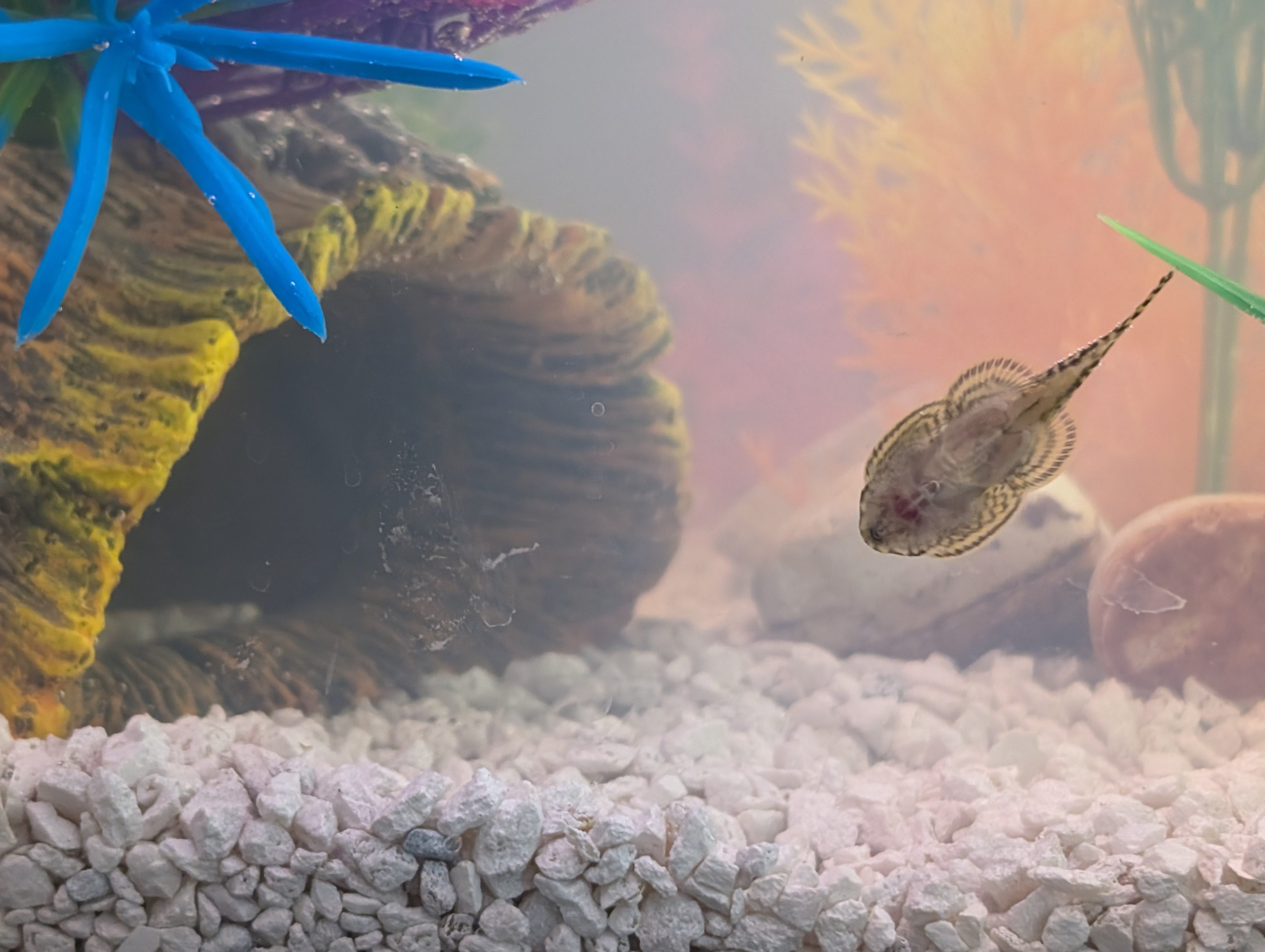
(DeGraw, Untitled [Photograph], August 2024, All Rights Reserved)